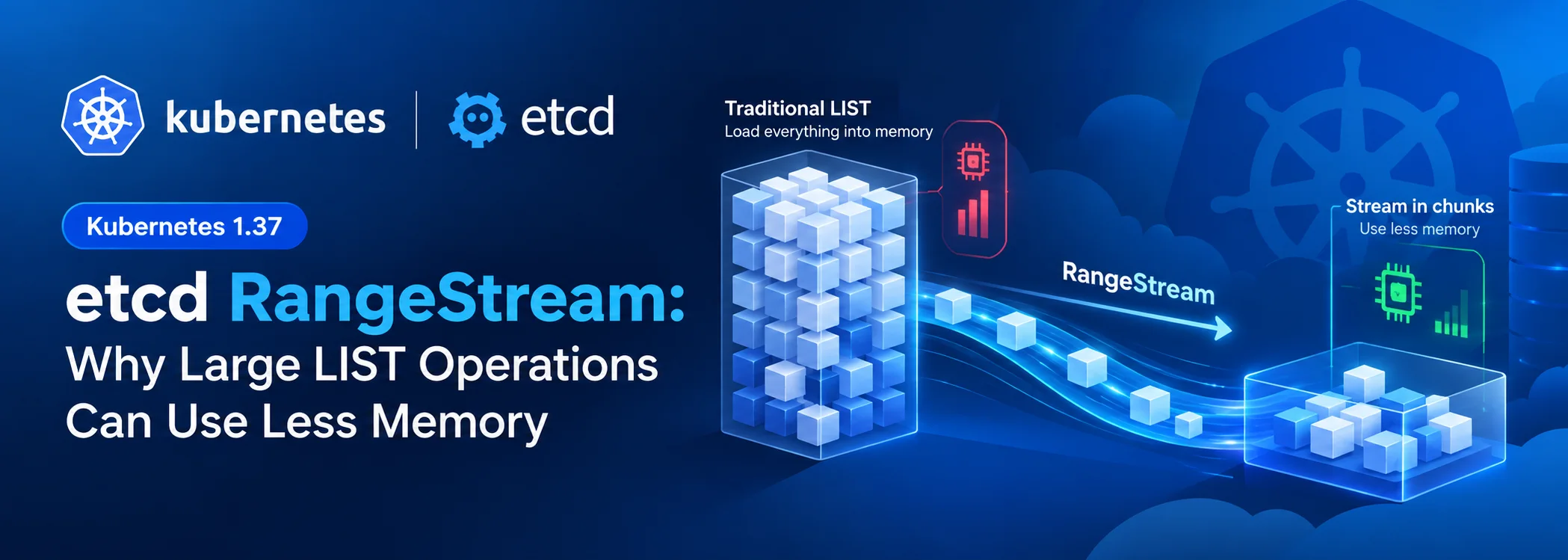
Updated September 1, 2026. Kubernetes 1.37 graduates etcd RangeStream to Beta when paired with etcd 3.7. The design streams large range reads instead of requiring each page to be assembled as one complete response, reducing peak memory in etcd and the API server during large collection reads.
Large clusters can fail in surprisingly mundane places: rebuilding a watch cache for many or unusually large objects can create memory spikes even when normal request rates look healthy. RangeStream attacks the shape of that peak rather than merely increasing limits.
A practical review checklist
- Check Kubernetes and etcd version compatibility.
- Measure API server and etcd memory during cache initialization and large LIST operations.
- Identify unusually large custom resources.
- Compare peak rather than only average memory.
- Do not treat the feature as a substitute for object-size and cardinality discipline.
Sources and verification
Primary source: Kubernetes Blog — “Kubernetes v1.37: etcd RangeStream Cuts Memory Use on Large List Reads” (September 1, 2026).
This article distinguishes confirmed release facts from engineering interpretation. Dynamic details such as support status, limits and availability should be rechecked against the primary documentation before a production change.